
Payments · Processing · Settlement
Lower card costs while keeping lines moving
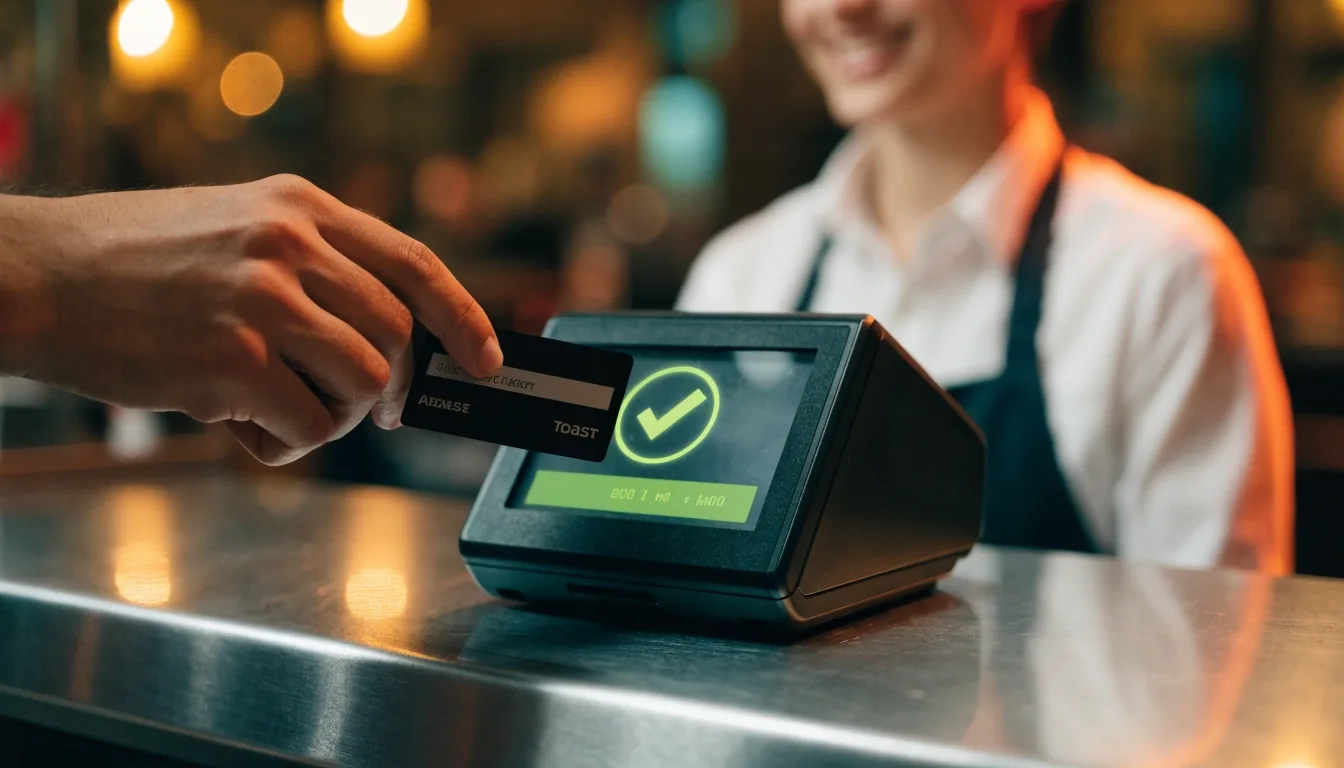
Toast Agent sets up Toast Payments so payments are fast at the counter and clear in reports. Toast describes its processing as built specifically for restaurants and handled through an integrated workflow. We review your current statements, explain fees plainly, and configure tips, refunds and close.
Toast Agent · toast-agent.com · Miami, FL · Monday–Friday 9:00 AM – 6:00 PM
- Launch window
- 5–7 days
- Statement review
- Interchange · assessments · markup
- Tenders enabled
- Card, tap, gift, cash, split, EBT SNAP
- Where we work
- Restaurants across the United States
What integrated means here
One stack for ordering and payment
With Toast POS, Toast says restaurant users are required to use Toast Payments. That single stack covers ordering and payment together. For an owner, the practical effect is fewer vendors to call when a reader fails on a Friday night — one team answers for the terminal, the tender and the ticket.
-
Encrypted at the point of payment
Card data is described as encrypted at the point of payment, so the number never rides through the open part of the system.
-
PCI Compliance in the workflow
PCI Compliance is framed as part of the platform rather than a separate add-on, which keeps the daily habits inside one system instead of three.
-
One call when it breaks
Ordering, terminals and tender arrive together, so the service window no longer routes between a POS number and a processor number while guests wait.
What this looks like on a Tuesday
A guest taps at the bar, the check lands on the right tab, tips route to the right role at close. That is what the integrated stack buys you — not a feature list, but fewer handoffs between systems at the moment the guest is ready.
Methods your guests expect
Every way your guest pays, enabled for your format
Toast lists support for card, contactless, gift card, cash, split payment and EBT SNAP use cases. We enable what fits your format — tap-to-pay at tables, bar tabs with pre-auth, quick-service tap at the counter, split checks for groups. Cash handling, drawer counts and gift card sales are trained by role.
Below is the working shape of each method — how it behaves at the counter and in the close report.
Card and tap at the table
Guest taps or inserts; the tender posts against the open tab or check.
Card and tap at the table
Guest taps or inserts; the tender posts against the open tab or check.
Table service gets a handheld so the guest never leaves the chair. Pre-auth on the bar tab keeps the walk-away tab safe while the queue stays cheap to clear at close.
Counter tap for quick service
Contactless at the turn of the counter, sized for a lunch rush.
Counter tap for quick service
Contactless at the turn of the counter, sized for a lunch rush.
Reader placement at the till is measured against the guest's reach. A tap clears in less than a second at the wire, and the ticket prints or dings without a second step.
Gift card and store credit
Sold at the counter, redeemed at the counter, tracked in the close.
Gift card and store credit
Sold at the counter, redeemed at the counter, tracked in the close.
Gift card sales and redemptions close with the day — no separate spreadsheet, no reconciliation on Monday morning. Staff are trained per role on open, redeem and refund.
Split checks and EBT SNAP
Handled as workflows, not as exceptions staff work around.
Split checks and EBT SNAP
Handled as workflows, not as exceptions staff work around.
Splits for parties of eight, tender swaps at a busy bar, EBT SNAP as a supported use case. The aim is a consistent motion at the counter so the queue does not stall on the payment step.
Method availability depends on your format, menu and jurisdiction — we confirm what fits before setup.
Reading your current statement
What is actually on the statement — and where the cost hides
We walk through interchange, assessments and processor markup in plain language. No invented savings promises. We compare your effective rate history with the Toast Payments structure and show where voids, refunds and keyed entries add cost. Small changes like tap instead of keyed entry often matter more than headline rates.
The network fee. Set by card brand and card type — rewards cards cost more than a plain debit swipe, and the statement usually buries that per-card difference inside one blended line.
The network's own charge on top of interchange. Small per transaction, uniform across card types — which is why it is easy to overlook and just as easy to correctly plan for.
What your processor charges as a service. The markup is where hierarchy in a fee schedule actually shows — a per-ticket rate that the header line does not disclose.
Every time a card is typed in by hand, or a check is voided and rerun, the transaction prices higher. Tap at the counter beats keyed entry — most shifts see hundreds of taps against a handful of keyed cards, and the difference shows up at the month close.
Bring last month's statement and we will read it with you line by line. The review does not commit you to anything — it is the way we decide together whether Toast Payments fits your volume.

A note on promises
We will not quote a savings figure before we have read your statement. Any number we give after that is drawn from your own history, not from a brochure.
Setup that prevents slow lines
Speed is decided before the guest arrives
Reader placement, Wi-Fi strength at tables, tip-screen wording and receipt options all affect speed. We shorten tip prompts to clear choices. Split-payment practice prevents bottlenecks for parties of eight. Offline-mode limits are explained so staff know when to switch tactics.
-
Reader placement
Handheld at the table for full service, counter reader for quick service, a second reader at the bar. Measured against the guest's reach, not just where the cable drops.
-
Wi-Fi at the table
We check signal at the tables where the handhelds live, and add an access point if that is what the tap speed needs. Weak signal is the common cause of a slow tap.
-
Tip prompts and receipts
Short tip prompts clear guests faster than a wall of options. Print, text or email — set per format, not per manager's mood that day.
-
Split and offline practice
Staff rehearse a split for a party of eight. Offline-mode limits are documented so nobody is guessing when the wire drops — the service keeps running.
Tips, refunds and comps
The close decides how Monday looks
Tip pooling rules, declared tips and payout timing are set with managers. Permissions control who can void, comp or refund. End-of-day reports separate tips by role — which is what connects payments to payroll later, and what stops Monday from being a re-entry exercise.
Pooling rules per role, declared tips at the moment they are earned, payout timing against your pay cycle. Managers set the rules; the system applies them.
Second-set-of-eyes approval on any refund over the threshold. The permission is separate from the server permission, and the trail is in the daily report.
Manager comps are keyed to reason codes, so the close tells you what was comped and why — not just that something was.
- Set with your managers
- Pooling rules, declared-tip policy and payout timing are written with the people who enforce them, not handed over as a default.
- Roles, not personalities
- Who can void, who can comp, who can refund — attached to roles so a shift change does not become a permissions audit.
Payments close and payroll data meet on the same report — see how we wire the second half.
Security habits for managers
The habits that keep card data where it belongs
Card data handling stays inside the integrated workflow. Manager cards, passwords and device locks are set from the first shift. Refund approvals require a second set of eyes. We review what PCI Compliance language means in daily habits — updated devices, controlled access, clean close procedures — because the framework only holds when the shift does.
-
01
Devices stay updated
Readers, terminals and handhelds are on the current software reachable to the restaurant — the platform does what it promises only when the device is not two versions behind.
-
02
Access is controlled
Manager cards, named passwords and device locks tied to roles — the shift change leaves nothing open, and nobody carries another person's credentials.
-
03
Close is clean
A written close routine — drawer counts, refund approvals signed off, reports run before the lights go off. Clean close procedures are what auditors read first.
-
04
Refunds need two sets of eyes
Above a threshold you set, a refund triggers a manager approval. The pattern of refunds and voids then shows up in the daily report rather than in a surprise later.
Multi-unit view
One dashboard instead of five inboxes
Groups see payments by location, by daypart and by tender type. Refund patterns and void patterns surface quickly. Menus stay consistent while tax rules vary by jurisdiction. Owners review one dashboard instead of five inboxes — and the reporting language is the same for every site.
- By location
- Compare a busy Friday at the flagship against the same shift three miles away, in the same view.
- By daypart
- Lunch, dinner and late-night tender mix read against the schedule, so staffing decisions and processing costs are decided together.
- By tender type
- Card, tap, gift card and cash split out so a shift in guest behaviour shows up as a shift in the report, not as a quiet erosion of margin.
- Refunds and voids
- Patterns surface quickly across the group — whether it is a training gap at one site or a genuine problem at another.
When Toast Payments is not ideal
Some kitchens should wait — and we will say so
If you are locked in a long processing contract, we review exit dates and fees before scheduling cutover. Some formats with unusual tender needs require extra review. We outline options and timing honestly rather than forcing a date — a move that hurts your operation on paper is not a move we recommend.
The same applies to timing. If a renegotiation window is closer than a cutover is comfortable, waiting is the answer we will give.
Common questions
Q1
What payment methods does Toast support?
Per Toast materials: card, contactless, gift card, cash, split payment and EBT SNAP use cases through the integrated workflow.
Q2
Will switching processors interrupt service?
Activation is staged before cutover and tested with small transactions. The live switch happens between services — most restaurants are live before the next dinner rush.
Q3
What do I need to prepare for the statement review?
Two recent statements, one of them a full month, plus the current processor contract if you have one. From those two documents we can read interchange, assessments and markup with you and give a real recommendation.
Q4
How long does Toast Payments take to switch?
The payments leg usually runs inside the 5–7 day implementation window when the contract review does not add wait time. If it does, we sequence payments after the rest of the stack is live rather than holding the whole launch.
Where we sit
Miami office, United States restaurants
Toast Agent runs implementations across the United States from our Miami base. If you are evaluating a switch, the fastest next step is a statement review — a call with the two documents in hand.
- Address
- 1200 Brickell Ave, Suite 1950, Miami, FL 33131, USA
- Phone
- +1-305-555-0182
- [email protected]
- Hours
- Monday to Friday: 9:00 AM – 6:00 PM
Office
1200 Brickell Ave, Suite 1950, Miami, FL 33131 — Monday to Friday, 9:00 AM – 6:00 PM.
Prefer to start with a review of the other pages? Menu migration and online ordering and payroll and back office carry the same level of detail for their half of the stack.